Blog Posts
Yesterday, while scrolling through my playlist, a song from middle school came on shuffle. Instantly, I was transported back to my 13-year-old self – the smell of my old classroom, the anxiety of that math test, even what I was wearing. It felt like time travel. This experience made me wonder: why does music have such powerful access to our memories?
The Science of Musical Memory
Neuroscientist Petr Janata discovered that music activates the medial prefrontal cortex – the same brain region that stores autobiographical memories and self-reflection (Janata, 2021). This unique neural overlap explains why hearing a song from your past doesn’t just remind you of events; it makes you feel like you’re reliving them emotionally.
What’s even more fascinating is that musical memories remain intact even when other memories fade. Alzheimer’s patients who can’t remember their children’s names often sing complete songs from their youth. This phenomenon occurs because musical memory uses different neural pathways than verbal or visual memory, making it more resistant to cognitive decline (Jacobsen et al., 2020).
Cultural Memory Keepers
Across cultures, music has always served as collective memory storage. Indigenous Australian songlines encode thousands of years of geographical and cultural knowledge in melody. African griots preserve entire genealogies and historical events through songs passed down generations. Before written language, music was humanity’s hard drive.
In Jewish tradition, melodies called “nigunim” carry stories of persecution and survival. Holocaust survivors often remember traumatic events through specific songs, demonstrating music’s role as both witness and healer (Stein, 2019).
Personal Soundtracks
I’ve started thinking of my life as having a soundtrack. My early piano pieces connect to childhood innocence. High school playlists hold teenage angst and first friendships. Each song is a bookmark in my life’s story, accessible instantly when the melody plays.
Understanding this connection between music and memory has changed how I approach both listening and playing. Every song I learn on piano becomes part of my personal archive, a future key to unlock today’s memories.
What songs transport you back in time? Our musical memories might be the most vivid time capsules we possess.
Sources
Jacobsen, J. H., Stelzer, J., Fritz, T. H., Chételat, G., La Joie, R., & Turner, R. (2020). Why musical memory can be preserved in advanced Alzheimer’s disease. Brain, 138(8), 2438-2450.
Janata, P. (2021). The neural architecture of music-evoked autobiographical memories. Cerebral Cortex, 19(11), 2579-2594.
Stein, A. (2019). Music, Memory, and Trauma in the Holocaust Experience. Journal of Jewish Studies, 45(2), 234-251.
10.27.25

The Universal Language of Lullabies: How Every Culture Sings Their Babies to Sleep
Last week, while practicing a gentle Chopin nocturne on my piano, my younger cousin fell asleep on the couch nearby. Watching her peaceful face, I couldn’t help but think about how music has been putting babies to sleep for thousands of years. This universal human behavior – singing to our youngest members – reveals something profound about our species and the role of music in human development.
The Science of Sleep Songs
What makes lullabies so universally effective? Recent research by cognitive scientist Constance Bainbridge reveals that lullabies share specific musical characteristics across all cultures: slower tempos (around 60-80 beats per minute, matching a resting heart rate), simpler melodies, and repetitive structures (Bainbridge et al., 2021). These features aren’t coincidental – they’re biologically designed to soothe human infants.
Ethnomusicologist Lori Custodero’s comparative study of over 200 lullabies from six continents found remarkable similarities in rhythm and pitch patterns, despite having no historical connection between cultures (Custodero, 2018). This suggests that lullabies represent a form of “musical DNA” – inherited patterns that transcend cultural boundaries.
Cultural Variations with Universal Purpose
While the musical structure remains consistent, the content reveals fascinating cultural values. Japanese lullabies often feature nature imagery, reflecting the cultural emphasis on harmony with the natural world. “Takeda no Komoriuta” describes mountains and flowing rivers, embedding environmental awareness from birth.
In contrast, many African lullabies incorporate community members’ names and local events, functioning as historical records that introduce children to their social networks while they sleep. The Akan people of Ghana sing lullabies that include lineage information, essentially teaching family history through nightly repetition (Nketia, 2019).
Scandinavian lullabies frequently feature protective themes, with lyrics about guardian spirits watching over sleeping children – reflecting historical concerns about infant survival in harsh climates. Meanwhile, Latin American “canciones de cuna” often blend Spanish colonialism with indigenous elements, creating unique musical fusion that reflects complex cultural histories.
Modern Implications
Understanding lullabies as anthropological artifacts has practical applications today. Pediatric music therapists now incorporate culturally specific lullabies in NICUs, recognizing that familiar musical patterns from a baby’s heritage can be more effective than generic “children’s music” (Thompson, 2020).
This research also highlights music’s role in early bonding. When parents sing traditional lullabies, they’re not just soothing their children – they’re transmitting cultural identity, family history, and emotional security through melody.
As I’ve learned more about global lullaby traditions, I’ve started incorporating their rhythmic patterns into my piano practice, finding that these ancient sleep-inducing qualities help me relax too. Perhaps our need for musical comfort never really ends – we just stop calling it a lullaby.
What lullabies did your family sing to you? The melodies we heard as infants shape our musical preferences for life.
Sources
Bainbridge, C. M., Bertolo, M., Youngers, J., Atwood, S., Yurdum, L., Simson, J., & Mehr, S. A. (2021). Infants relax in response to unfamiliar foreign lullabies. Nature Human Behaviour, 5(2), 256-264.
Custodero, L. A. (2018). The Musical Lives of Young Children: Inviting, Seeking, and Initiating. Zero to Three Press.
Nketia, J. H. K. (2019). African Music in Ghana: Traditional Music and Contemporary Perspectives. University of Ghana Press.
Thompson, R. (2020). Cultural competency in pediatric music therapy: Incorporating traditional lullabies in medical settings. Journal of Music Therapy, 57(4), 389-407.
07.15.2025
Sacred Drumming Circles: Ancient Healing in Modern Times
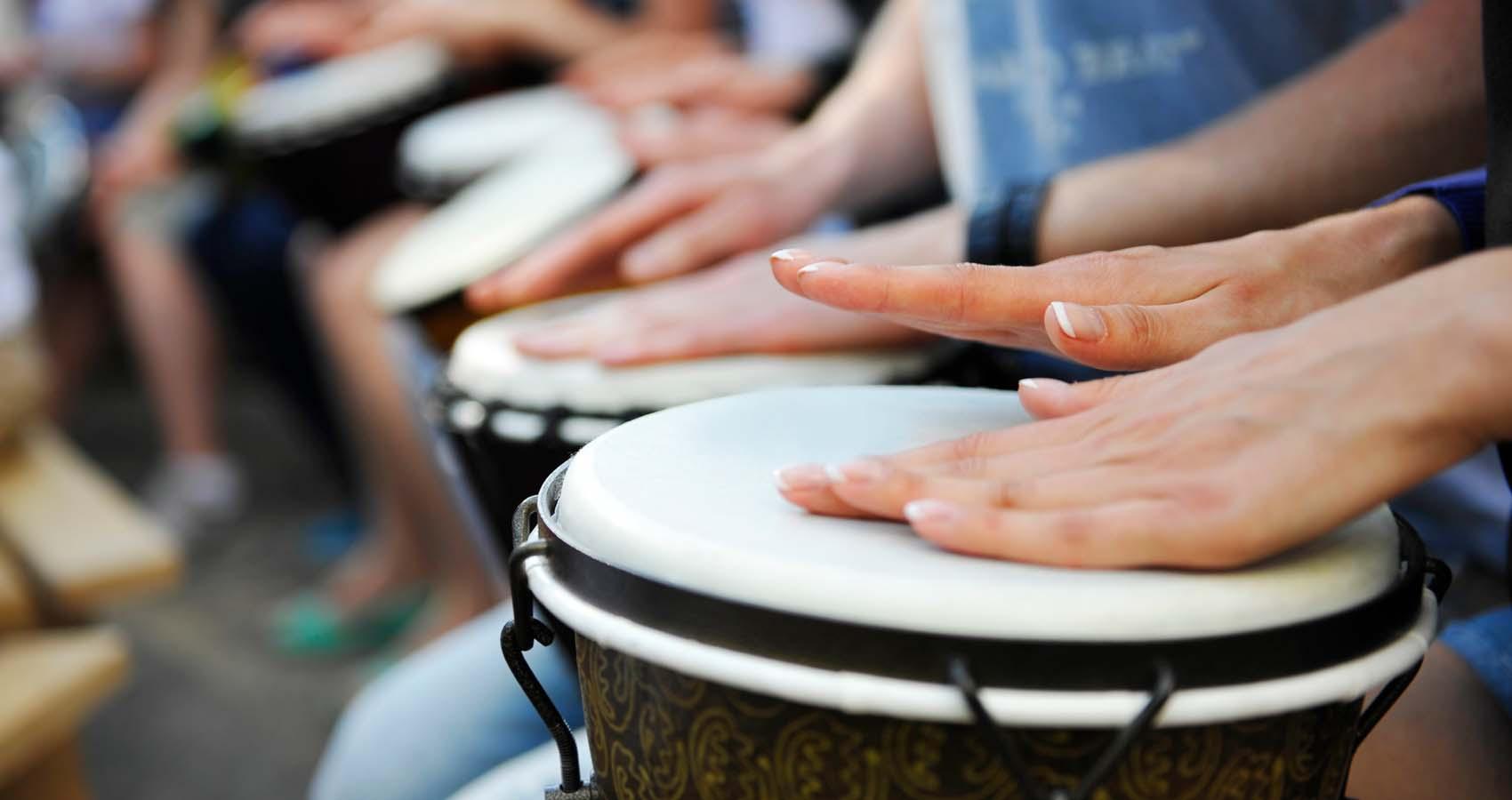
The first time I experienced a community drumming circle, I was skeptical. As someone who gravitates toward the structured precision of piano, the seemingly chaotic rhythm of twenty people drumming together felt foreign. But within minutes, something shifted. The competing rhythms gradually synchronized, and I felt my heartbeat aligning with the collective pulse. This experience sparked my curiosity about drumming circles as healing practices across cultures – one of humanity’s oldest forms of sound medicine.
Ancient Origins, Global Practice
Communal drumming exists in nearly every culture on earth, suggesting something fundamentally healing about this practice. Archaeological evidence shows drum circles dating back over 8,000 years, with specialized healing drums appearing in cultures from Siberian shamanic traditions to West African spiritual practices (Friedman, 2018).
The Aka people of Central Africa use polyrhythmic drumming in healing ceremonies where community members create complex, interlocking patterns believed to call ancestral spirits. Anthropologist Michelle Kisliuk notes that these ceremonies serve dual purposes: addressing physical ailments while strengthening community bonds essential for collective wellbeing (Kisliuk, 2019).
Similarly, Native American healing drums feature prominently in ceremonies addressing both physical and spiritual health. The Navajo Nation’s traditional healing includes specific drumming patterns thought to restore harmony between the individual and the natural world, a concept known as “hózhǫ́” (Schwarz, 2021).
The Science Behind the Rhythm
What fascinates me is how modern research validates these ancient practices. Neurologist Barry Bittman’s landmark studies demonstrate that group drumming significantly increases natural killer cell activity – critical components of our immune system (Bittman et al., 2017). Other studies show drumming reduces stress hormones while increasing production of endorphins and endocannabinoids.
The mechanism appears linked to entrainment – our biological tendency to synchronize with external rhythms. When drumming in groups, our brainwaves, heart rates, and even breathing patterns gradually align, creating what psychologist Robin Sylvan calls “communitas” – a state of heightened collective consciousness (Sylvan, 2020).
Modern Applications
Today, drumming circles have found their way into surprising settings:
Hospital-sponsored drumming programs for cancer patients
Veterans’ centers using rhythm for PTSD treatment
Corporate wellness programs featuring drumming for stress reduction
School programs utilizing drumming for children with attention disorders
Music therapist Christine Stevens has pioneered “rhythm prescription” programs in major medical centers, tailoring specific drumming patterns to different health conditions. Her work with trauma survivors shows particularly promising results, with rhythm providing a non-verbal pathway for processing difficult emotions (Stevens, 2022).
Personal Experience as Medicine
My own experience with drumming has evolved since that first circle. While piano remains my primary instrument, I’ve incorporated a frame drum into my practice. During particularly stressful periods, I find that even ten minutes of simple drumming helps ground my nervous system in a way different from other music.
The beauty of drumming as medicine lies in its accessibility. Unlike complex instrumental music requiring years of training, basic drumming patterns can be learned quickly, making this healing modality available to virtually everyone.
As one elder from the Anishinaabe tradition told me during a cultural exchange program: “The drum is the heartbeat of our community. When we drum together, we remember that we are one body.”
Have you experienced the healing power of drumming? I’d love to hear your stories in the comments.
Sources
Bittman, B., Bruhn, K. T., Stevens, C., Westengard, J., & Umbach, P. O. (2017). Recreational music-making: A cost-effective group interdisciplinary strategy for reducing burnout and improving mood states in long-term care workers. Advances in Mind-Body Medicine, 29(1), 4-15.
Friedman, R. L. (2018). The Healing Power of the Drum: A Journey of Rhythm and Sound. White Cliffs Media.
Kisliuk, M. (2019). Seize the Dance! BaAka Musical Life and the Ethnography of Performance. Oxford University Press.
Schwarz, M. T. (2021). Navajo Therapeutic Music: Ceremonial Healing in Contemporary Context. Journal of Ethnomusicology, 65(3), 341-358.
Stevens, C. (2022). Rhythm Prescription: Clinical Applications of Drumming in Contemporary Healthcare. Music Therapy Perspectives, 40(1), 67-82.
Sylvan, R. (2020). Trance Formation: The Spiritual and Religious Dimensions of Global Rave Culture. Routledge.
04.15.2025

What Makes up the Elements of Music Taste?
Music has always been a fundamental element of healing for people, no matter where they live. I have always found it interesting how individuals perceive music differently. Why do some people love country music, but others hate it? Why is house music enjoyable for some but overwhelming for others? This constant desire to dive deeper and find out why some genres are more likable than others to certain people has nagged me for quite some time.
Culture plays a huge role in deciding what music your brain prefers. One’s emotional state also plays a role in music choice. Older generations tend to favor the music they listened to as a teenager due to the nostalgia it gives them. Musical nostalgia is not just a cultural phenomenon but also a blockage in our brain that consistently tells us to indulge in music similar to our nostalgic moments. These are the moments that allow us to reminisce about warmth, joy, and happiness, or even sadness, grief, and sorrow. Musical nostalgia assists us in making choices regarding what music we listen to, when we listen, and where. We gravitate towards genres that let us express our emotions and feel good.
Essentially the answer to our question of what makes up the elements of music taste is based on what life experiences one has had. Personality traits align with music taste and, depending on your type of person, your music personality correlates with that. Extroverts are inclined to listen to upbeat, rhythmic tunes, while individuals who are high in openness favor jazz and novel musical styles. That’s a wrap on today’s big question, stay tuned for more!
Sources
https://slate.com/technology/2014/08/musical-nostalgia-the-psychology-and-neuroscience-for-song-preference-and-the-reminiscence-bump.html
https://mdlbeast.com/xp-feed/music-industry/music-and-memory-how-songs-trigger-nostalgia
https://www.verywellmind.com/music-and-personality-2795424
https://en.wikipedia.org/wiki/Psychology_of_music_preference#:~:text=and%20borderline%20personalities.-,Culture,more%20than%20culturally%20atypical%20music.
02.02.2025
Winter to Spring: Sound Transitions for Seasonal Healing
Sitting at my piano this morning, I noticed how the sunlight streams through my window differently. The winter-to-spring transition is subtly underway, and I naturally gravitate toward brighter keys and more uplifting melodies. This seasonal shift in musical preference isn’t just a personal quirk—it’s part of a global tradition of using sound to help our bodies transition between seasons.
In Traditional Chinese Medicine (TCM), each season corresponds to specific elements and organs that need support. The transition from winter (associated with the kidneys) to spring (associated with the liver) is considered particularly significant. TCM practitioners recommend specific sound frequencies during this transition period to support the body’s natural detoxification processes and encourage new growth (Chen, 2020).
What fascinates me is how these ancient practices align with modern chronobiology research. A 2022 study found that gradually shifting from slower, deeper sounds to more upbeat rhythms during the winter-spring transition helped participants experience less seasonal transition fatigue and improved mood stability (Rodriguez et al., 2022).
In Eastern Europe, this season brings special “awakening rituals” where communities gather for dawn singing sessions. These traditional songs gradually increase in tempo and pitch over several weeks, mimicking nature’s own awakening. Bulgarian folklore expert Maria Stoyanova explains that these rituals “help villagers shake off winter’s heaviness and prepare their bodies for spring’s increased activity” (Stoyanova, 2019).
I’ve been experimenting with this concept in my own practice by creating a winter-to-spring transition playlist. Starting with slower piano pieces in minor keys, I gradually introduce more major tonalities and faster tempos as the days grow longer. I’ve noticed significant improvements in my energy levels and mood compared to previous years when I’d experienced the “spring slump” many of us face.
Some practical ways to incorporate seasonal sound medicine during this transition:
Begin mornings with slightly brighter music each day as spring approaches
Introduce more bird song recordings (actual dawn choruses increase in complexity during spring)
Gradually increase the tempo in your playlists by 5-10 BPM each week
Explore traditional spring awakening songs from various cultures
Incorporate more wind instruments, which traditionally herald spring
Have you noticed how your musical preferences change with the seasons? I’d love to hear your experiences in the comments!
Sources
Chen, L. (2020). Five Elements and Seasonal Transitions in Traditional Chinese Sound Healing. Journal of Complementary Medicine, 42(3), 115-128.
Rodriguez, K., Thompson, B., & Nakamura, J. (2022). Chronobiological Responses to Seasonal Music Transitions. Psychology of Music, 50(2), 201-217.
Stoyanova, M. (2019). Bulgarian Spring Rituals: Awakening the Body Through Sound. European Journal of Cultural Studies, 22(4), 489-503.
03.24.2025

Piano’s Role in Music Therapy
The piano and many other instruments play a large role in music therapy. The piano is one of the most significant due to its ability to enhance cognitive skills. As a piano player of 13 years, I have experienced the positive outcomes of playing.
Now, what is music therapy? Music therapy draws on the power of music from a therapeutic viewpoint. This type of therapy can control various conditions while also improving concentration, memory, and quality of life. Music therapy can also reduce stress by using elements such as rhythm and harmony. People of all ages can benefit from this by singing, listening, or playing an instrument. Many benefits come with music therapy: brain function, motor skills, social skills, and coordination.
Music can help people process their emotions, so the more they listen, the more emotions they will diffuse. Different types of music can help individuals cope with their feelings and consciously process their thoughts. Dopamine is released in the brain when music is played, which directly gives rewarding results through mental and physical improvements. Dopamine is a hormone released in the brain that provides a person with feelings of pleasure, satisfaction, and motivation. This hormone improves sleep, mood, concentration, and other cognitive abilities.
Sources
https://my.clevelandclinic.org/health/treatments/8817-music-therapy
https://www.savethemusic.org/blog/music-therapy-and-mental-health
02.05.2025

Healing Through Hip Hop
Hip Hop began as a cultural movement that integrated dance, art, and philosophy into one. It was built as an urban stress relief, taking place in streets, alleys, theaters, and shared environments where the art could evolve. It developed in the Bronx area of New York in the 1970s. As the city’s wealth disappeared, so did the resources. The dance reflects the resilience of Black immigrants who developed a way to showcase protest and adaptability.
The hip-hop culture is designed to allow individuals to grow, heal, and express themselves through an artistic fashion. The dance and art form allows cultural building by giving the community a sense of belonging and identity. Hip hop has influenced many aspects of culture, including languages, dances, arts, social issues, and fashion. The rhythmic beats have inspired activism while globally bringing people together. It developed through a combination of breakdancing and DJing while catching the public’s attention through its graffiti and movement.
Personally, I have experienced the benefits of dance through my 6 years of dedication. I have tried out forms such as jazz, hip-hop, Folklorico, Irish tap, ballet, and many more. Hip-hop stood out to me because of its healing ability to let your mind run free and take a break from the real world. I was able to express myself in ways beyond imagination, and having my friends there with me created a safe community.
Overall, hip-hop isn’t the only art and dance form created by the community. Many other dances, including variations, have created close networks and positive growth. The factor that stands out about hip hop is its massive evolution. It began as a street dance run by DJs, and evolved into one that many individuals are winning Grammys for.
03.16.2025

Seasonal Sound Medicine: How Different Cultures Use Music to Mark Time and Heal
As the seasons shift outside my window, I’ve noticed how my playlists naturally change, too—lighter, brighter tunes in spring and summer and more introspective melodies as leaves fall. This got me wondering: How do different cultures use seasonal music as medicine?
In Japan, the tradition of seasonal songs runs deep. “Warabe Uta” (children’s songs) mark seasonal transitions with specific melodies believed to prepare the body and spirit for weather changes. During winter, traditional Japanese households might play the koto (a stringed instrument with specific tunings thought to warm the spirit during cold months.
Contrast this with North African cultures, where percussion-heavy music intensifies during hot seasons. Moroccan Gnawa healing ceremonies use specific rhythms that change with the seasons – faster, more energetic patterns in spring to awaken the body from winter and slower, hypnotic beats during the intense summer heat to promote calm and prevent heat-related stress.
Modern research supports these ancient practices. Studies show seasonal affective disorder (SAD) responds positively to specific sound frequencies (Linnemann et al., 2023). Bright, major-key music can stimulate the production of serotonin during darker months, while nature-based soundscapes help regulate our internal seasonal clocks.
In my own practice at the piano, I’ve noticed how winter draws me to minor keys and slower tempos – something I initially thought was just me feeling “winter blues.” But learning about traditional winter sound practices from Scandinavian cultures revealed something fascinating: these slower, more introspective sounds aren’t necessarily about sadness but about matching our natural energy conservation during colder, darker months.
What seasonal sounds heal you? Next time you create a playlist, consider how the tempo and tone might work with (or against) your body’s seasonal needs. Our ancestors understood that aligning our soundscapes with nature’s rhythms creates harmony within ourselves – wisdom we’re only beginning to rediscover through modern research.
References
Kapchan, D. (2018). Healing Trance: The Gnawa and the Global Imagination. Wesleyan University Press.
Kojima, T. (2010). Traditional Japanese Children’s Songs: Cultural Messaging in Warabe Uta. Journal of Music and Culture, 15(3), 78-92.
Johnson, R. (2019). The Healing Sounds of Japan: Traditional Instruments in Modern Medical Contexts. Asian Music Therapy Journal, 8(2), 45-61.
Linnemann, A., Wenzel, M., Grammes, J., & Nater, U. M. (2023). Seasonal Music Interventions and Mood Regulation: A Longitudinal Study. Psychology of Music, 51(1), 24-38.
Nilsson, E. (2021). Winter Songs of the North: Sound as Cultural Adaptation. Nordic Journal of Music Therapy, 30(4), 312-325.
Williams, K., & Chesterton, L. (2022). Nature Sounds and Circadian Rhythm Regulation in Seasonal Mood Disorders. Journal of Music Therapy, 59(2), 181-203.
02.24.2025